Detect fraud in milliseconds by modeling what normal behavior looks like, not by memorizing fraud patterns. Powered by Hamiltonian Neural Networks.
DarkWatch: Physics-Informed Fraud Detection
Traditional fraud detection relies on static rules: flag transactions over $10,000, block purchases from high-risk countries, require verification for new devices. Fraudsters learn these rules and work around them. Rule-based systems also generate excessive false positives, frustrating legitimate customers.
DarkWatch takes a fundamentally different approach, borrowed from physics. In classical mechanics, closed systems conserve energy, the Hamiltonian of the system remains constant over time. DarkWatch applies this principle to user behavior: each customer has a behavioral "energy state" represented as a vector trajectory in high-dimensional space.
Hamiltonian Neural Networks (HNNs) learn the underlying energy function that governs normal behavior. Rather than memorizing specific transaction patterns, HNNs learn the generator of the motion, the mathematical structure that produces legitimate behavior. This allows DarkWatch to recognize fraud not by matching known fraud signatures, but by detecting violations of behavioral physics.
How DarkWatch Works
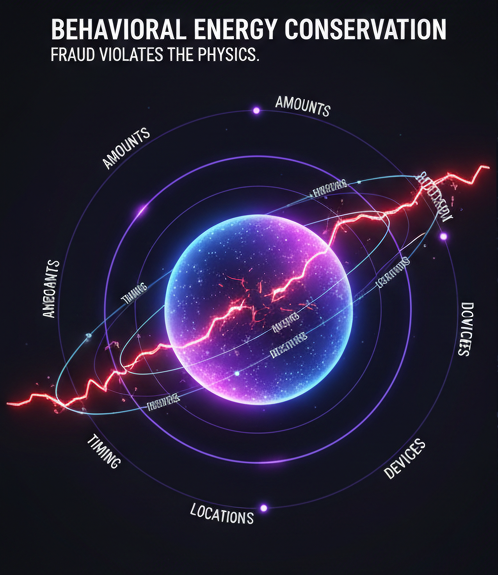
Behavioral Energy Conservation
Every customer has a behavioral "energy state": their typical transaction amounts, timing, merchants, locations, and devices. DarkWatch learns this state as a mathematical system that conserves energy over time. Normal transactions follow the expected trajectory. Fraud violates the physics.
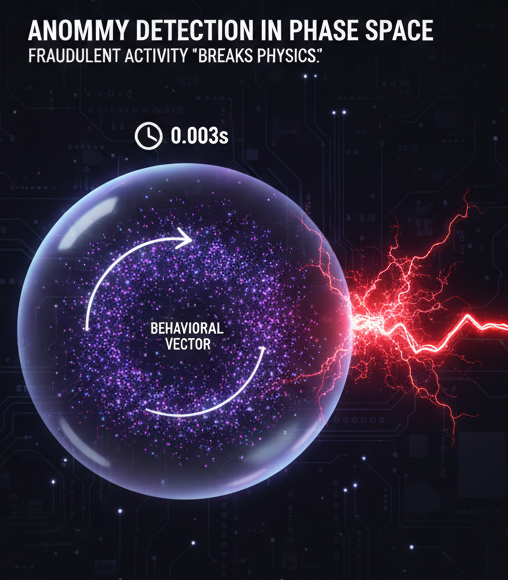
Anomaly Detection in Phase Space
When a transaction arrives, DarkWatch calculates whether it conserves the expected energy. Legitimate activity stays within bounds. Fraudulent activity "breaks physics", the behavioral vector drifts into regions that should be inaccessible. Detection happens in single-digit milliseconds.
Standard neural networks, while powerful, often struggle to respect invariant laws like energy conservation. Over long prediction horizons, they accumulate "drift", predicted states spiral away from physical reality. This manifests as either excessive false positives (flagging normal behavior as anomalous) or false negatives (missing fraud that should violate behavioral physics).
HNNs enforce symplectic structure, a geometric property of phase space that guarantees conservation laws are respected. Research on physical systems (pendulums, springs, three-body problems) shows that while baseline networks allow energy to drift significantly over time, HNNs maintain bounded oscillation almost indefinitely. They generalize better because they learn the mathematical structure, not just surface patterns.
DarkWatch applies this same advantage to fraud detection. The system doesn't need exhaustive rules for every fraud type, it learns what normal looks like and flags everything that violates the physics of normal behavior.
DarkWatch FAQs
How fast is real-time detection?
DarkWatch returns anomaly scores in single-digit milliseconds, suitable for inline transaction authorization. The Hamiltonian evaluation is a single forward pass through the neural network plus gradient computation, highly optimized for low latency. At scale, this translates to $100 in downstream cost savings per prevented fraudulent transaction, catching bad actors before they cause damage to your business and brand.
What types of fraud does DarkWatch detect?
Any fraud that causes behavioral deviation: account takeover, synthetic identity, transaction fraud, application fraud, and insider threats. Because DarkWatch detects anomalies rather than matching known fraud signatures, it catches novel fraud patterns that haven't been seen before.
How does DarkWatch handle legitimate behavior changes?
The system continuously updates user models as new legitimate behavior is confirmed. A customer who moves to a new city will generate initial anomalies, but as transactions are verified, DarkWatch learns the new behavioral state. Stochastic extensions to the Hamiltonian framework handle noise and gradual drift without over-alerting.
Can DarkWatch integrate with my existing fraud stack?
Yes. DarkWatch is designed as a complementary layer. Feed it transaction data via API, and it returns anomaly scores that your existing orchestration system can incorporate alongside rules, consortium data, and other models. Many customers use DarkWatch to catch fraud that passes existing rules.
Transform your data into Revenue today with DarkWatch
Experience immediate impact with our straightforward integration process and easily measure the benefits of DarkWatch