
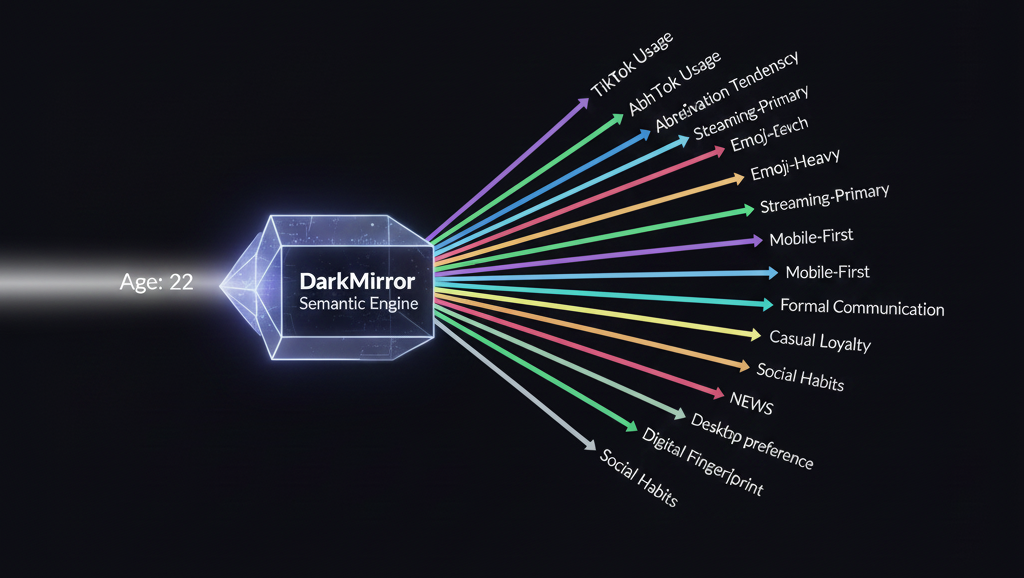
DarkMirror transforms sparse data into rich audience intelligence. A single "Age: 22" field becomes 12+ targetable signals, from "Gen Z" and "Digital Native" to "Rental Market" and "Social Media Heavy." Combine demographic attributes with behavioral personas like "Luxury Shoppers" or "Discount Hunters" to build composite audiences that deliver 22% higher reach with greater precision.
Explore the full mapping behind each dimension. Every age value maps to statistically validated behavioral signals and targeting applications.
Generational identity shapes communication preferences, brand relationships, and media consumption. DarkMirror detects generational signals through behavioral patterns — not just birth year.
| Birth year | Generation | Behavioral signals we detect | Targeting application |
|---|---|---|---|
| ≥ 1997 | Gen Z | High emoji frequency, TikTok engagement, casual syntax, streaming-only media, mobile-first, authenticity-seeking | Social ads, influencers, short-form video, mobile UX, authentic brand voice |
| 1981–1996 | Millennial | Experience preference, brand-values alignment, subscription affinity, delayed milestones, multi-platform | Subscriptions, experience marketing, values messaging, streaming, podcasts |
| 1965–1980 | Gen X | Research-heavy journeys, marketing skepticism, quality focus, family spending, self-reliant decisions | Detailed content, trust signals, premium positioning, family value props, SEO |
| 1946–1964 | Boomer | Brand loyalty, traditional media, phone preference, health consciousness, established patterns | TV/print, relationship marketing, call centers, health & wellness, trusted brands |
| < 1946 | Silent | Print preference, face-to-face value, fixed income, caregiver influence, established brand trust | Direct mail, phone outreach, simplified messaging, caregiver targeting |
Life stage determines priorities, purchasing power, and decision-making context. A 35-year-old first-time parent has different needs than a 35-year-old career-focused professional.
| Age | Life stage | Characteristics | Marketing approach |
|---|---|---|---|
| 18–22 | College Age | Education-focused, peer-influenced, budget-conscious | Student discounts, social proof, campus channels |
| 23–27 | Early Career | First job, establishing independence, building credit | Professional development, starter products, career tools |
| 28–34 | Young Professional | Quality upgrades, relationship milestones, growing income | Premium entry-level, milestone marketing, aspirational |
| 35–42 | Established Adult | Family formation, career advancement, time scarcity | Family-centric, convenience premium, time-saving |
| 43–52 | Mid Career | Peak earnings, established preferences, brand loyalty | Quality over price, brand relationships, premium tiers |
| 53–59 | Late Career | Wealth accumulation, legacy thinking, experience-rich | Premium experiences, wealth services, legacy planning |
| 60–66 | Pre-Retirement | Transition planning, downsizing, bucket list | Retirement prep, travel, experience over things |
| 67–74 | Active Retirement | Leisure-focused, health-aware, grandparent role | Travel, health/wellness, grandchildren, hobbies |
| 75–84 | Senior | Health priority, simplified needs, trusted relationships | Health services, simplified messaging, trust signals |
| 85+ | Elderly | Caregiver-influenced, accessibility needs, fixed routines | Caregiver targeting, senior care, estate services |
Digital fluency determines channel effectiveness. Reaching a Digital Native on direct mail wastes budget; reaching Limited Digital users only through apps misses them entirely.
| Age | Digital behavior | Behavioral indicators | Channel strategy |
|---|---|---|---|
| < 23 | Digital Native | Mobile-only, app-centric, social-first, short attention spans | TikTok, Instagram, Snapchat, YouTube Shorts, in-app experiences |
| 23–42 | Tech Savvy | Multi-device, app + web, streaming, digital-commerce comfortable | Cross-platform, email, podcasts, streaming ads, responsive web |
| 43–59 | Selective Digital | Desktop preference, trusted platforms only, longer-form OK | Email (highly effective), Facebook, LinkedIn, search, detailed content |
| 60+ | Limited Digital | Phone/mail important, family assistance common, simple UX | Direct mail, phone, Facebook, larger text/buttons, simplified flows |
Economic life stage determines product fit. A renter needs different financial products than a homeowner; someone accumulating wealth has different needs than someone decumulating.
| Age | Economic behavior | Financial context | Product affinity |
|---|---|---|---|
| < 18 | Dependent | No independent purchasing power | Target parents/guardians, family bundles |
| 18–27 | Rental Market | Renting, building credit, entry-level income | Renter's insurance, starter credit, flexible subscriptions |
| 28–34 | First Home Buyer | Transitioning to ownership, major-purchase readiness | Mortgages, home insurance, furniture, appliances |
| 35–59 | Suburban Transition | Family housing, established income, asset building | Family vehicles, life insurance, home improvement |
| 53–59 | Wealth Accumulation | Peak earning years, investment focus, discretionary spend | Investment products, estate planning, luxury goods |
| 60–66 | Downsizing Likely | Simplifying, converting assets, prepping for retirement | Real estate, moving services, reverse mortgages, travel |
| 67+ | Fixed Income | Retirement income, preservation focus, budget-conscious | Medicare supplements, senior services, value messaging |
Experience immediate impact with our straightforward integration process and easily measure the benefits of DarkMatch