In the modern financial landscape, data is often touted as the "new oil." However, for many large institutions, that oil is trapped in disconnected reservoirs. When customer data remains trapped within organizational silos, it doesn't just hinder marketing, it obscures risk and inflates operational overhead.
This article explores how a leading national bank leveraged vectorized unification to bridge the gap between disparate business units, achieving a unified "Golden Record" and significant bottom-line results.
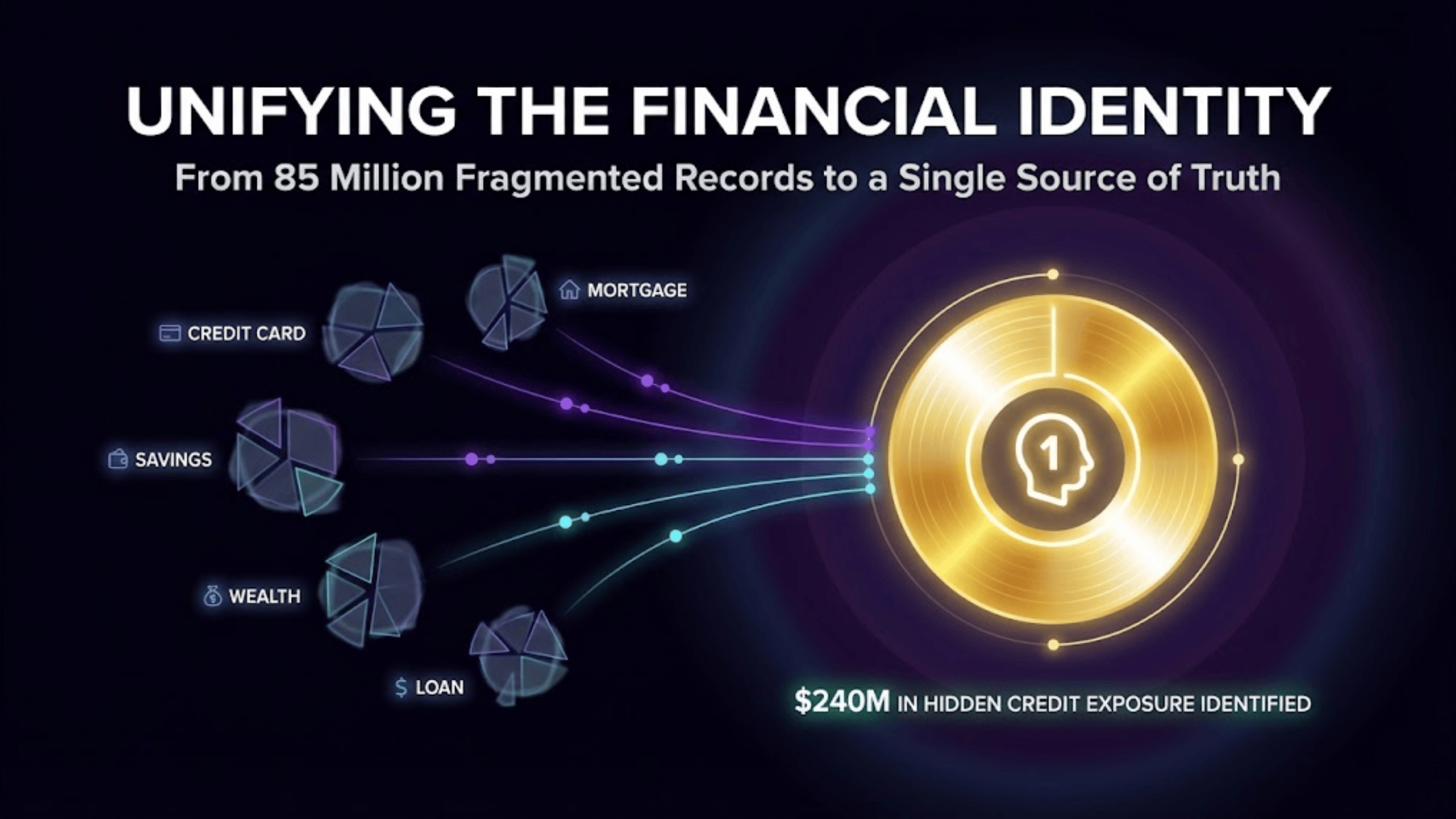
The project focused on a National Bank within the Financial Services sector, managing a massive scale of 85 Million Records. By moving away from legacy matching systems, the institution achieved a 15% Reduction in Data Infrastructure Costs and uncovered nearly a quarter-billion dollars in hidden risk.
For years, the institution operated its Mortgage, Credit Cards, and Wealth Management divisions as independent entities. Each department maintained its own legacy database, and the "glue" holding them together, basic identity matching, was failing.
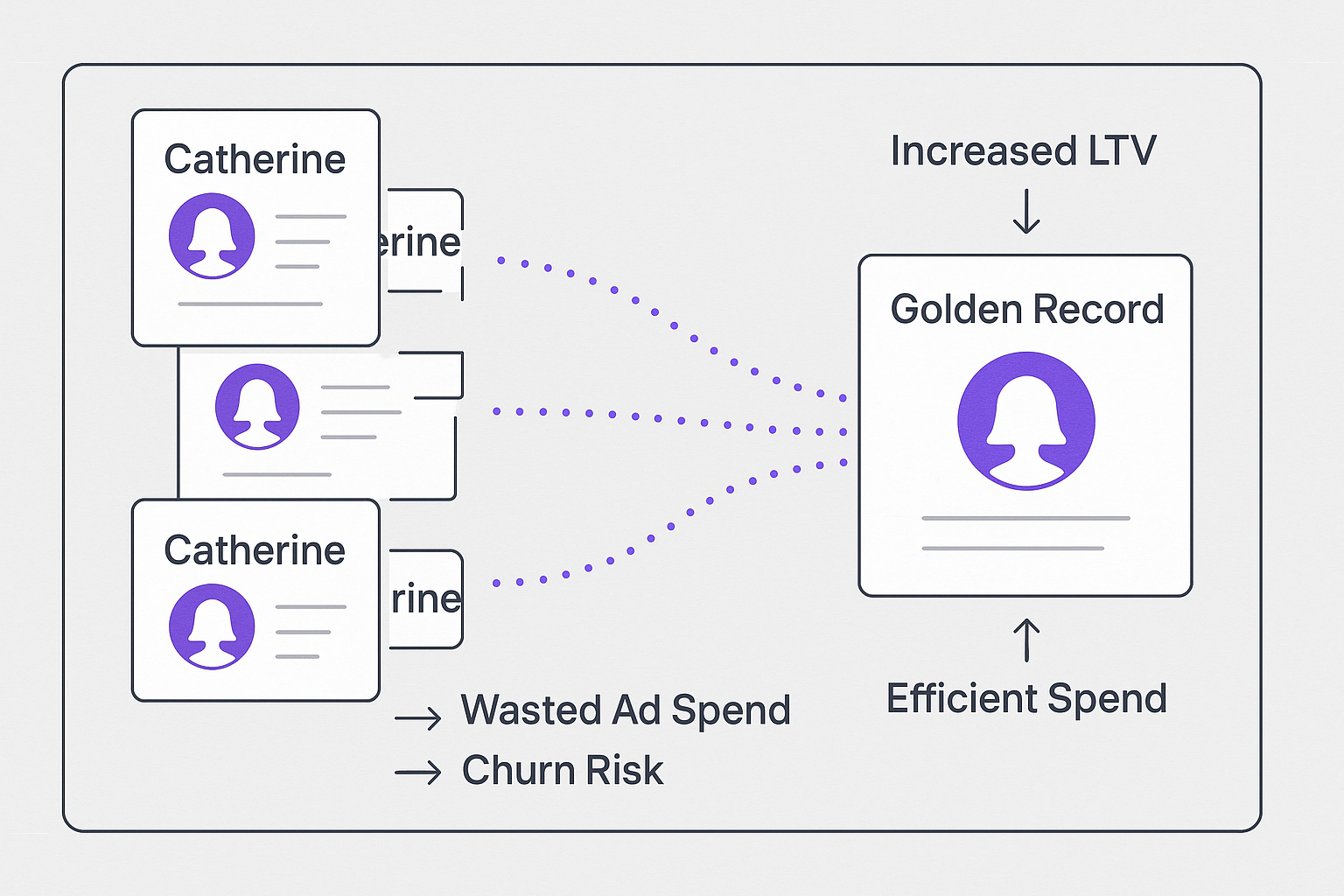
The primary culprit was an over-reliance on deterministic matching. These legacy systems required exact text strings to bridge records. If "J. Smith" applied for a mortgage and "Jonathan Smith" held a premium credit card at the same address, the system saw two different people. This lack of nuance created a "split-brain" architecture that resulted in two critical organizational failures:
Blind Risk Exposure: The risk management team was unable to calculate the Total Aggregate Exposure for high-net-worth clients. An individual could be over-leveraged across multiple products, but because their profiles weren't linked, they appeared to be low-risk, independent actors in each silo.
Compounding Operational Waste: The bank was essentially paying a "fragmentation tax." They were storing the same data multiple times, paying for redundant cloud compute, and, most visibly, sending multiple sets of high-cost compliance mailers and marketing materials to the same household.
To solve the identity crisis, the bank moved away from rigid, rule-based logic and deployed DarkMatch. This platform utilizes Vectorized Unification to ingest the bank’s raw ecosystem and treat data as more than just static text.
Semantic Gravity Analysis
Rather than looking for exact character matches (e.g., "Street" vs. "St."), the DarkMatch models utilized Semantic Gravity Analysis. This approach maps data points into a multi-dimensional vector space.Instead of strict rules, the model analyzes the "gravitational pull" between data points. By examining the proximity of geolocation history, device IDs, and transaction behaviors, the system identified that what appeared to be five distinct profiles actually belonged to a single individual. This probabilistic approach allows for high-confidence matching even when PII (Personally Identifiable Information) is incomplete or inconsistent across departments.
Golden Record Creation
The final step was the collapse of these duplicates into an immutable "Golden ID." This persistent identifier acts as a universal key, ensuring that regardless of which department a customer interacts with, the data flows back to a single, unified source of truth.
The transition from fragmented silos to a unified identity layer yielded immediate dividends across three primary categories:
1. Enhanced Risk Visibility
By correctly linking high-debt individuals across disparate accounts, the bank identified $240M in previously "hidden" credit exposure. This allowed the risk team to recalibrate credit limits and improve the bank’s overall capital adequacy by recognizing the true debt-to-income ratio of their most active clients.
2. Marketing and Communication Efficiency
By eliminating the "identity noise," the bank stopped sending redundant outreach. This led to a 22% saving in direct mail and communication costs. Households that previously received three separate promotional packets now receive one cohesive, personalized message, significantly improving the customer experience.
3. Infrastructure Optimization
Data bloat is a silent profit killer. By identifying and merging redundant customer rows, the bank released 15% of its data storage capacity. This didn't just lower storage bills; it improved query performance and reduced the compute power required for daily analytical processing and nightly batch jobs.
This case study proves that identity resolution is no longer just a "data cleanup" task, it is a strategic imperative. In an era of tightening margins, the ability to see a customer clearly across the entire enterprise is the difference between calculated risk and blind exposure.